Esi the Brave classroom activity pack
English-language edition | October 2026 | bernard.ink
Esi the Brave activity pack
Read together. Wonder together. Make something your own.
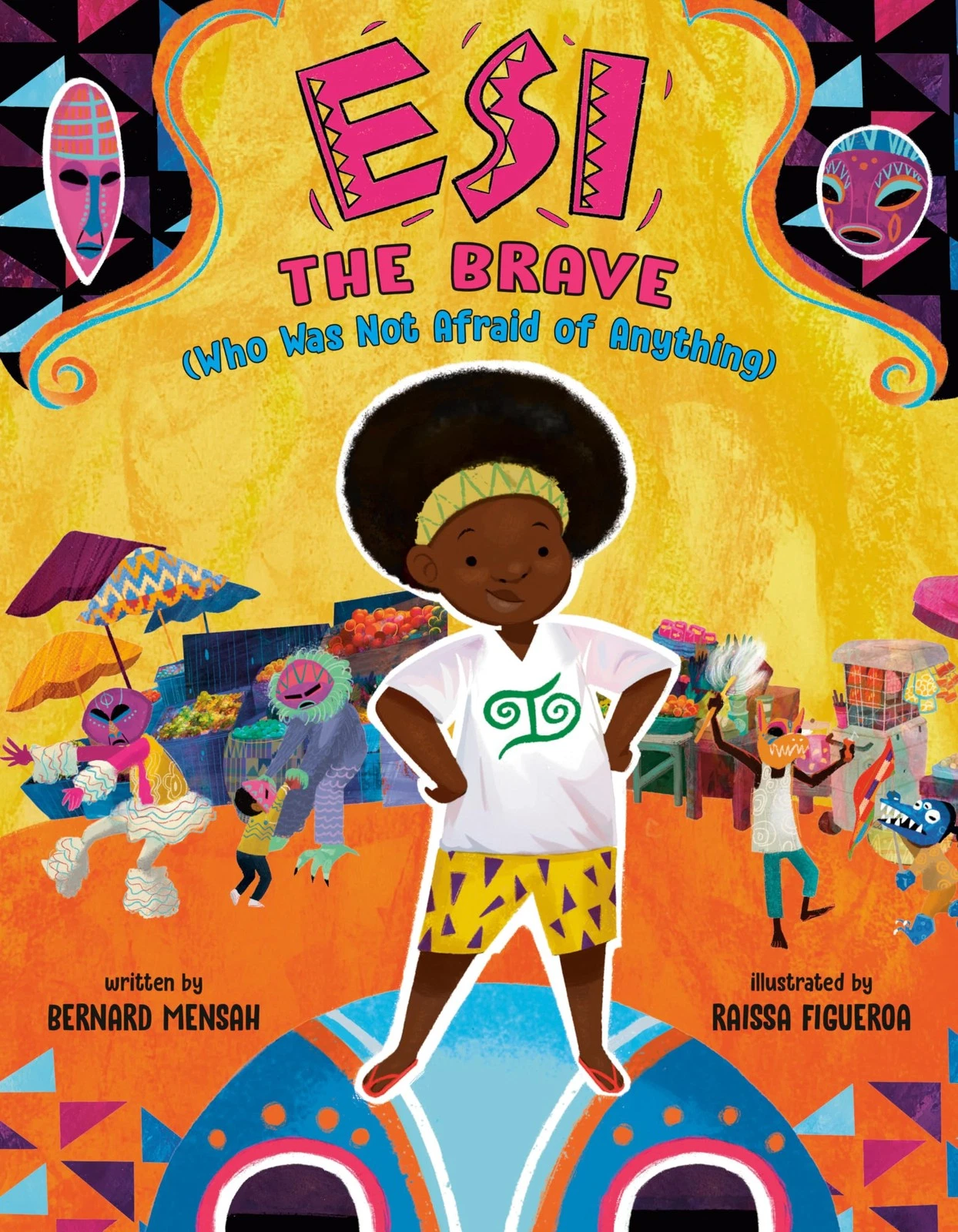
Cover illustration: Raissa Figueroa
Free English-language printables | Ages 4-8
By Bernard K. Mensah | Use alongside a copy of the book.
Original teaching materials. Cover artwork remains credited to the book's illustrator and publisher.
Choose your classroom journey
What is inside
- Esi: courage in the story (3 pages)
- A small brave moment (2 pages)
- Twelve courage conversation cards (3 pages)
- Festival and community explorer (2 pages)
- Repeating-pattern studio (2 pages)
A simple session
- Read aloud (10 minutes): pause for a prediction and let children notice the pictures.
- Talk (10 minutes): select a few questions and accept oral, drawn or written answers.
- Make or write (15-25 minutes): choose one printable, not every activity at once.
- Share (5 minutes): invite volunteers to explain one choice or new idea.
Support and stretch
Offer oral rehearsal, adult scribing and larger print as needed. Older readers can add evidence or connected sentences. Each activity includes its own Teacher notes and suggested responses.
Print what you need
Print pupil pages in black and white. Keep teacher pages digitally. Use the web edition for selectable text and structured headings. English only; website language selection does not translate this download.
What makes Esi brave?
Read Esi the Brave together. Look back at the pictures when you explain your ideas.
- Where does Esi go with her family?
- What happens when Esi cannot find Mummy and Daddy?
- What might Esi feel in that moment? Point to a picture that helps you decide.
Feelings can change
- Before the festival - draw, say or write your response.
- When she is separated - draw, say or write your response.
- At the end - draw, say or write your response.
Tell a partner: Esi is brave because ...
Look closer; think further
- Why might the masked dancers feel frightening to Esi?
- Can someone feel afraid and still act bravely? Use Esi to explain.
- How do the pictures and sounds make the festival feel busy?
Draw a scene that helps explain your answer.
My picture shows ...
Teacher notes
Purpose and preparation
20-25 minutes. Notice how a character responds to a difficulty.
Read the book aloud first. Have one copy available to revisit words and pictures. Pupil pages are suitable for black-and-white printing.
Suggested responses
Esi visits the Kakamotobi Festival with her family. She becomes separated from her parents among masked dancers. She tries to get her parents back. Feelings and reasons may differ: require an illustration or action as evidence, not one fixed emotion. The dancers are festival performers, not proof of real monsters.
Support and stretch
Support: Use three feeling pictures or gesture choices; an adult can scribe.
Stretch: Compare Esi at the start and end; give two clues supporting an interpretation.
Teaching links
England KS1 English: discuss stories and infer from actions. US Grade 1 RL.1.3: describe characters and events; SL.1.2: answer questions about a read-aloud.
These are suggested links, not an accredited lesson or a complete curriculum. Grade 1 links do not apply automatically to younger children.
Accept spoken, drawn, dictated or written responses. Do not assess handwriting when the learning focus is understanding.
Sources and teaching references
A small brave moment
Bravery can be asking for help, trying something new or saying how you feel. You may invent a character instead of sharing a personal experience.
Draw your character and their brave moment.
Say your story first
- At first, my character felt ...
- They decided to ...
- Someone helped by ...
- At the end ...
Write one sentence, or ask an adult to write your words.
Teacher notes
Purpose and preparation
20 minutes. Rehearse a short sequence aloud, then draw or write it.
Read the book aloud first. Have one copy available to revisit words and pictures. Pupil pages are suitable for black-and-white printing.
Suggested responses
There is no single correct story. Look for a feeling, a manageable action and an outcome. A useful example is a character nervous about a new club who asks a trusted adult to go with them.
Support and stretch
Support: Use puppets or pictures; keep the task to one spoken sentence.
Stretch: Write two or more events using first, next and finally; reread with a partner.
Teaching links
England Year 1 writing: say ideas aloud before writing. US Grade 1 W.1.3: recount sequenced events; W.1.5: develop ideas with adult guidance.
These are suggested links, not an accredited lesson or a complete curriculum. Grade 1 links do not apply automatically to younger children.
Keep sharing optional. Do not invite accounts of trauma or suggest that being brave means taking unsafe risks.
Sources and teaching references
Courage conversation cards
Cut on the dashed lines. Choose two or three cards after reading; everyone may pass.
- 1. What does Esi say about being afraid at the beginning?
- 2. Which picture shows a change in Esi's feelings?
- 3. How could you describe the festival using a sound?
- 4. What helps Esi keep going?
- 5. Can asking for help be brave? Why?
- 6. What would you say to a character who feels worried?
More things to wonder
- 7. How can a place feel exciting and overwhelming at the same time?
- 8. What might a trusted grown-up do when a child feels lost?
- 9. Does everyone feel brave in the same situations?
- 10. What makes a celebration special to a family?
- 11. What do you notice about the masks and costumes in the illustrations?
- 12. What is one kind thing a community can do to help someone?
Teacher notes
Purpose and preparation
10-15 minutes. Practise listening and explaining ideas without forcing personal disclosure.
Read the book aloud first. Have one copy available to revisit words and pictures. Pupil pages are suitable for black-and-white printing.
Suggested responses
Accept varied responses. Ask children to distinguish what the book shows from what they imagine. Fear is a feeling, not a failure. No pupil needs to represent Ghana or a whole community.
Support and stretch
Support: Offer a partner rehearsal, a drawing or an option to pass.
Stretch: Invite a child to respond to a classmate: I agree because ... or I wonder ...
Teaching links
England spoken language: listen, explain ideas and build on responses. US Grade 1 SL.1.1: collaborative conversation; SL.1.2: questions about a read-aloud.
These are suggested links, not an accredited lesson or a complete curriculum. Grade 1 links do not apply automatically to younger children.
Use cards 1, 2 and 4 to return to the story, then choose broader prompts. Agree a simple rule: one speaker, careful listening, no pressure to share.
Sources and teaching references
Festival and community explorer
Esi's story takes place at the Kakamotobi Festival in Winneba, Ghana. Ghana is a country in West Africa. One story cannot show every Ghanaian celebration or family.
Find it together
- Using a globe or atlas, find Africa. Locate Ghana with an adult.
- Find Winneba using an atlas or a digital map. What is nearby?
Notice; do not guess
In the book I can see ...
A celebration I know has ...
One thing I would like to ask about the festival ...
Teacher notes
Purpose and preparation
20 minutes. Locate a story setting and compare celebrations respectfully.
Read the book aloud first. Have one copy available to revisit words and pictures. Pupil pages are suitable for black-and-white printing.
Suggested responses
Africa is a continent; Ghana is a country. Winneba is on Ghana's coast. Children should use the atlas rather than infer geography from a costume. Similarities might include family, music or a gathering; differences require observation, not stereotypes.
Support and stretch
Support: Use a large labelled atlas and a partner; accept pointing or drawing.
Stretch: Record a question and name a reliable source or person who could help answer it.
Teaching links
England KS1 English: discuss vocabulary and information. US Grade 1 SL.1.2: answer questions about information presented orally.
These are suggested links, not an accredited lesson or a complete curriculum. Grade 1 links do not apply automatically to younger children.
Teacher preparation: locate Ghana and Winneba beforehand. Use the story illustrations for festival observations. Do not describe all Ghanaian people as sharing one tradition.
Sources and teaching references
Repeating-pattern studio
This is a pattern-making extension, not a scene from Esi's story. Look at a verified photograph of woven Kente with an adult. Notice repeating shapes and colour.
Choose two shapes. Draw a small repeating unit in the first row. Continue it across the grid; then colour your own design.
Printable design grid: 8 rows by 12 columns. Use squared paper as an alternative.
Download the PDF for this printable template.
My repeating unit is ...
This is my own paper pattern, not a traditional Kente design.
Teacher notes
Purpose and preparation
20 minutes. Explore repetition and explain a design choice.
Read the book aloud first. Have one copy available to revisit words and pictures. Pupil pages are suitable for black-and-white printing.
Suggested responses
A repeating unit might be triangle, square, triangle, square. Accept any repeat the child can explain. Do not assign a universal traditional meaning to a colour or shape.
Support and stretch
Support: Start with an AB repeat or use stamp shapes.
Stretch: Try an AAB or ABC unit and explain how to continue it.
Teaching links
England KS1 art: explore drawing, colour, pattern and texture. US Grade 1 SL.1.5: use a drawing to explain an idea. The art task is not itself an ELA standard.
These are suggested links, not an accredited lesson or a complete curriculum. Grade 1 links do not apply automatically to younger children.
Use a museum or UNESCO source when introducing Kente. Ghana's weaving traditions are varied. The worksheet is a contemporary classroom design, not a reproduction of a named cloth.