Jollof Day classroom activity pack
English-language edition | October 2026 | bernard.ink
Jollof Day activity pack
Read together. Wonder together. Make something your own.
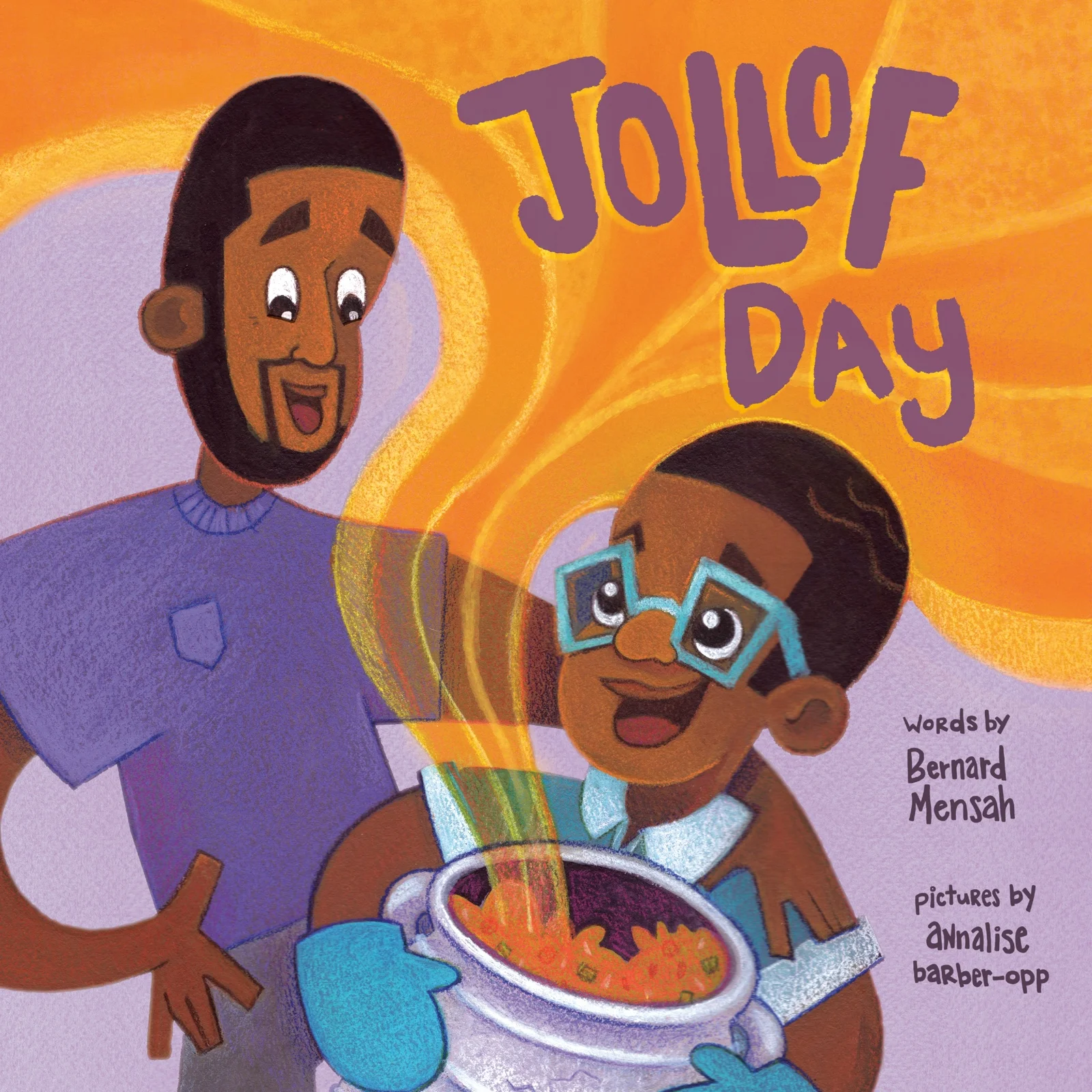
Cover illustration: Annalise Barber-Opp
Free English-language printables | Ages 3-8 with adult support
By Bernard K. Mensah | Use alongside a copy of the book.
Original teaching materials. Cover artwork remains credited to the book's illustrator and publisher.
Choose your classroom journey
What is inside
- From kitchen to table (2 pages)
- Kitchen action word cards (3 pages)
- Colour a kitchen; draw a meal (2 pages)
- Bernard's Jollof Day recipe (4 pages)
A simple session
- Read aloud (10 minutes): pause for a prediction and let children notice the pictures.
- Talk (10 minutes): select a few questions and accept oral, drawn or written answers.
- Make or write (15-25 minutes): choose one printable, not every activity at once.
- Share (5 minutes): invite volunteers to explain one choice or new idea.
Support and stretch
Offer oral rehearsal, adult scribing and larger print as needed. Older readers can add evidence or connected sentences. Each activity includes its own Teacher notes and suggested responses.
Print what you need
Print pupil pages in black and white. Keep teacher pages digitally. Use the web edition for selectable text and structured headings. English only; website language selection does not translate this download.
From kitchen to table
Read Jollof Day. Cut out the four cards. Arrange them in the order that makes sense in the story; check the book together. Lay the large cards on your table; write their letters in the order boxes.
- A. The family gets the table ready and shares the meal.
- B. The boy wakes his dad for Jollof Day.
- C. The rice cooks while the family waits.
- D. The boy and his dad prepare the ingredients.
Tell your sequence
- First - draw, say or write your response.
- Next - draw, say or write your response.
- Then - draw, say or write your response.
- Finally - draw, say or write your response.
First ... Next ... Then ... Finally ...
Teacher notes
Purpose and preparation
15-20 minutes. Retell four broad events using time words.
Read the book aloud first. Have one copy available to revisit words and pictures. Pupil pages are suitable for black-and-white printing.
Suggested responses
Suggested order: B, D, C, A. The boy wakes his dad; they prepare ingredients; the rice cooks; the family gets ready and shares the meal. These are broad summaries, not quotations or a card for every page.
Support and stretch
Support: Read cards aloud and act them out; younger children can point instead of cutting.
Stretch: Use the illustrations to add an event between two cards; explain where it belongs.
Teaching links
England KS1 English: discuss stories and infer from actions. US Grade 1 RL.1.3: describe characters and events; SL.1.2: answer questions about a read-aloud.
These are suggested links, not an accredited lesson or a complete curriculum. Grade 1 links do not apply automatically to younger children.
Cutting requires appropriate scissors and adult supervision. The activity assesses story sequence, not cutting skill.
Sources and teaching references
Kitchen action word cards
Cut and use these teaching words inspired by cooking. They are not an exhaustive list of words printed in the book.
- Wash - clean with water. Mime washing a tomato.
- Chop - cut into pieces. An adult does the cutting.
- Stir - move food around with a spoon. Mime a slow stir.
- Measure - find how much you need. Point to a measuring jug.
- Pour - tip liquid into something. Try an empty jug.
- Simmer - cook gently with small bubbles. This is an adult job.
Talk; match; move
- Taste - notice flavour with your tongue. Let hot food cool first.
- Share - give some to someone else. Show how you share a meal.
Play together
- An adult reads a card; everyone mimes safely away from a real cooker.
- Match a word to an ingredient or tool in a picture.
- Choose two words and tell a partner a cooking sequence.
Draw a tool and label the action it helps you do.
Teacher notes
Purpose and preparation
10-15 minutes. Understand and use action words in spoken explanations.
Read the book aloud first. Have one copy available to revisit words and pictures. Pupil pages are suitable for black-and-white printing.
Suggested responses
Wash: clean with water. Measure: decide the quantity. Simmer: cook gently, not stir fast. Accept child-friendly paraphrases. Avoid implying that every family cooks the same way.
Support and stretch
Support: Use objects, gestures and adult modelling.
Stretch: Explain a pair such as stir and pour; use each word in an instruction.
Teaching links
England spoken language: listen, explain ideas and build on responses. US Grade 1 SL.1.1: collaborative conversation; SL.1.2: questions about a read-aloud.
These are suggested links, not an accredited lesson or a complete curriculum. Grade 1 links do not apply automatically to younger children.
Keep mime play away from knives, hot pans and electrical tools. Words are teaching vocabulary; check the printed book before claiming an exact occurrence.
Sources and teaching references
Colour a kitchen
These are original classroom outlines, not pictures taken from Jollof Day. Colour the tomato, onion, pepper and rice bowl. Tell a partner what an adult might do with each.
Printable original outlines: tomato, onion, pepper and rice bowl. You can draw your own ingredients as an alternative.
Download the PDF for this printable template.
I can see ...
A meal worth sharing
Draw a meal and the people you would like to share it with.
At our table ...
Teacher notes: allow an invented meal or family. Ask what is similar to or different from the family meal in Jollof Day. Support and stretch: label one food orally, or write a sentence about sharing. Suggested teaching links: England KS1 art; Grade 1 SL.1.5 (use drawings to explain ideas).
Bernard's Jollof Day recipe
Serves 8 | Adapted from the supplied publisher proof, selected by Bernard on 5 October 2026. Cooking is adult-led. This educator edition has not been independently kitchen-tested.
Ingredients for the gravy
- Oil: enough to fry the onions without sticking.
- 3 large red onions, diced; 3-4 large yellow onions, quartered.
- 2 star anise; 2 bay leaves.
- A finger-sized piece of ginger; 4-5 garlic cloves.
- 400 g tomato paste; 1.6 kg fresh or canned tomatoes.
- 1-2 Scotch bonnet peppers, optional and adjusted to taste. An adult handles them.
- 20-30 g chicken stock seasoning, or your preferred equivalent; check its label and allergens.
- 2 teaspoons salt, adjusted to taste; 1 teaspoon rosemary; 1 teaspoon smoked paprika.
- All-purpose seasoning, thyme and ground anise, each to taste.
This makes more gravy than the rice needs. Set aside 700 ml for this batch; cool and refrigerate the remaining gravy promptly.
Make the gravy
Adult cooking steps
- Heat oil in a large pot. Add the diced red onions, star anise and bay leaves; cook gently until the onions are translucent.
- Blend the yellow onions, ginger and garlic until smooth. Add to the pot, stirring regularly. Add more oil if needed.
- When the mixture darkens and separates, add the tomato paste. Stir over low heat.
- Blend the tomatoes and optional peppers. Add them once oil rises from the tomato mixture. Bring to a sputter, reduce the heat and partially cover.
- Stir about every 15 minutes while the sauce reduces by roughly a quarter. Add stock seasoning, salt, rosemary, paprika and all-purpose seasoning to taste.
- Once the sauce is rich and oil rises to the surface, add thyme and ground anise. Simmer for another 10-20 minutes.
Cooker, knives, blender, steam and hot pans are adult jobs. Children may count washed ingredients or describe pictures from a safe place.
Cook the Jollof rice
Ingredients for the rice
- 1160 g good-quality long-grain rice, using your preferred variety.
- 700 ml prepared gravy.
- 4 1/2 cups hot water, using one consistent cooking cup measure.
- Salt to taste. Optional diced carrots and cabbage.
Adult cooking steps
- Wash and rinse the rice. Bring the measured gravy to a boil.
- Add the rice and hot water. Adjust the tomato colour with additional gravy and season to taste.
- Add carrots and cabbage if desired. Cover with parchment and a well-fitting lid; keep parchment away from flames. Simmer over low heat.
- After 10-15 minutes, check whether the grains are soft. If still firm, sprinkle in a little hot water, turn the rice and cover for another 10-15 minutes. Repeat as needed: timing depends on the rice and pan.
- Serve promptly with sides of your choice. An adult checks temperature before children taste.
The proof's water line has conflicting metric and cup quantities. This edition keeps its 4 1/2 cups and omits the conflicting metric figure. Optional whole eggs are omitted from the classroom adaptation.
Teacher notes Cook, talk and share
Purpose and preparation
Optional family or supervised school cooking. Check all ingredients, stock and seasoning labels for allergies and follow the school's food-hygiene procedures. Cooking is not required to enjoy the reading activity.
Source and editorial choices
Based on the recipe in the supplied Jollof Day publisher proof. Bernard selected the proof rather than the earlier Google Doc. The serving count is its eight-serving label; actual portions vary. Avoid mixing its rice gram quantity with the proof's conflicting rice cup conversion.
Support and stretch
Children may count ingredients, describe a smell from a safe distance or retell the kitchen-to-table sequence. An alternative is picture discussion with no food preparation or tasting.
Safe storage
Serve promptly. Cool leftover rice quickly, ideally within one hour; refrigerate and use within 24 hours. Reheat only once, until steaming hot throughout. Do not leave gravy overnight at room temperature; cool and refrigerate it promptly.
Teaching links
Suggested KS1 spoken language: describe actions and give an ordered explanation. US SL.1.2 can support an adult-led discussion; the cooking task itself is not an accredited literacy lesson.