Kente for Jojo classroom activity pack
English-language edition | October 2026 | bernard.ink
Kente for Jojo activity pack
Read together. Wonder together. Make something your own.
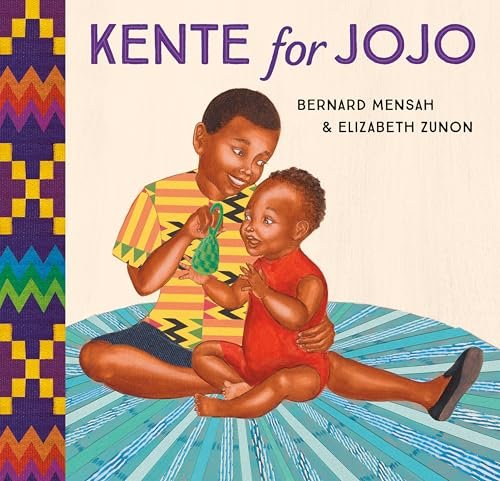
Cover illustration: Elizabeth Zunon
Free English-language printables | Ages 4-8
By Bernard K. Mensah | Use alongside a copy of the book.
Original teaching materials. Cover artwork remains credited to the book's illustrator and publisher.
Choose your classroom journey
What is inside
- A gift for baby Jojo (2 pages)
- Something special to me (2 pages)
- Kente: cloth, craft and care (2 pages)
- Paper weaving and pattern studio (3 pages)
A simple session
- Read aloud (10 minutes): pause for a prediction and let children notice the pictures.
- Talk (10 minutes): select a few questions and accept oral, drawn or written answers.
- Make or write (15-25 minutes): choose one printable, not every activity at once.
- Share (5 minutes): invite volunteers to explain one choice or new idea.
Support and stretch
Offer oral rehearsal, adult scribing and larger print as needed. Older readers can add evidence or connected sentences. Each activity includes its own Teacher notes and suggested responses.
Print what you need
Print pupil pages in black and white. Keep teacher pages digitally. Use the web edition for selectable text and structured headings. English only; website language selection does not translate this download.
A gift for baby Jojo
Read Kente for Jojo together. The narrator is Jojo's older sibling; Jojo is the new baby.
- Who wants to choose a special cloth for Jojo?
- Who helps the family find or make it?
- What does the rainbow help the family notice or choose?
Draw a moment that shows care for the baby.
This picture shows care because ...
Teacher notes
Purpose and preparation
20 minutes. Explain character relationships and give evidence from pictures.
Read the book aloud first. Have one copy available to revisit words and pictures. Pupil pages are suitable for black-and-white printing.
Suggested responses
Jojo's older sibling narrates. The family visits a skilled weaver to choose a special Kente cloth. A rainbow inspires their choice. Revisit the final spread where the sibling compares Jojo to Nyankonton. Accept observations about colour and care without assigning a universal meaning to every colour.
Support and stretch
Support: Point to characters and use an adult to scribe one idea.
Stretch: Compare the desire for a perfect gift with the care shown while making it.
Teaching links
England KS1 English: discuss stories and infer from actions. US Grade 1 RL.1.3: describe characters and events; SL.1.2: answer questions about a read-aloud.
These are suggested links, not an accredited lesson or a complete curriculum. Grade 1 links do not apply automatically to younger children.
Do not describe the plot as baby Jojo travelling alone or choosing the cloth. Invite children to point to the page that supports an answer.
Sources and teaching references
Something special to me
In Kente for Jojo, a cloth carries care for a new baby. Think of an object, picture or gift that feels special. You can invent one.
Draw your special thing.
It looks like ...
It is special because ...
I would tell someone ...
Teacher notes
Purpose and preparation
20 minutes. Describe an object and explain why it matters.
Read the book aloud first. Have one copy available to revisit words and pictures. Pupil pages are suitable for black-and-white printing.
Suggested responses
A valued object need not be expensive, inherited or connected to a particular family structure. Look for a descriptive detail and a reason. An example might be a pebble kept from a walk with a friend.
Support and stretch
Support: Let children point, tell an adult or choose from ordinary classroom objects.
Stretch: Write two connected sentences; add a detail that helps someone picture the object.
Teaching links
England Year 1 writing: say ideas aloud before writing. US Grade 1 W.1.2: describe a topic with facts; W.1.5: develop writing with adult guidance.
These are suggested links, not an accredited lesson or a complete curriculum. Grade 1 links do not apply automatically to younger children.
This is descriptive writing, so suggested US links are W.1.2 (informative description) and W.1.5 (adult-supported development), rather than a promise to teach an entire narrative standard.
Sources and teaching references
Kente: cloth, craft and care
Four things to know
- Kente is a woven textile associated with Ghana.
- Weavers make narrow strips on looms; strips can be joined to make a larger cloth.
- Designs can communicate stories, sayings and community histories. Different designs and traditions carry different meanings.
- People learn the craft through family teaching, apprenticeships and other learning settings. It is a living craft that continues to change.
True or false?
- Ghana is a continent.
- Kente cloth can be made from joined woven strips.
- Every Kente design means exactly the same thing.
- A skilled craft can be learned from another person.
Atlas task: find Ghana in West Africa. Use an adult's map to locate Bonwire, a Ghanaian weaving community.
Teacher notes
Purpose and preparation
20 minutes. Separate a sourced fact from an assumption.
Read the book aloud first. Have one copy available to revisit words and pictures. Pupil pages are suitable for black-and-white printing.
Suggested responses
1 False: Ghana is a country in Africa. 2 True. 3 False: designs have different names and meanings. 4 True. Ask children to explain one answer using the fact sheet. Bonwire is a Ghanaian weaving community; Kente is also associated with other communities and traditions.
Support and stretch
Support: Read one fact aloud at a time and let pupils answer with gestures.
Stretch: Ask how a source helps us check a claim; look at a verified cloth and pose a respectful question.
Teaching links
England KS1 English: discuss vocabulary and information. US Grade 1 SL.1.2: answer questions about information presented orally.
These are suggested links, not an accredited lesson or a complete curriculum. Grade 1 links do not apply automatically to younger children.
Avoid a universal colour-meaning chart or assigning personal designs the status of traditional cloth. The source below describes Ghana's diverse craft, not one unchanging rule.
Sources and teaching references
Make a paper loom
This classroom model helps us notice over-under weaving. It is not a traditional loom or authentic Kente cloth. An adult supervises scissors.
- Cut out the large rectangle. Fold it along the middle horizontal line.
- With adult help, cut the vertical slot lines from the fold to the marked stop points. Do not cut the outer border.
- Unfold. Cut the strips from the other printable page.
Printable paper loom: a rectangular border, centre fold and seven slot lines that stop before the outer edge. An adult can prepare slots in folded paper.
Download the PDF for this printable template.
Keep the uncut border around your loom. A grown-up can prepare the slots for younger children.
Weave; then design
Cut out the six strips. Slide the first over, under, over, under the loom bands. Start the next strip under, over. Gently push strips together.
Six long rectangular weaving strips. An adult may prepare equivalent strips from coloured paper.
Download the PDF for this printable template.
Plan your own repeating unit
Printable design grid: 4 rows by 12 columns. Use squared paper as an alternative.
Download the PDF for this printable template.
My design repeats ...
Teacher notes
Purpose and preparation
30-40 minutes. Explore a basic over-under structure and explain a repeating pattern.
Read the book aloud first. Have one copy available to revisit words and pictures. Pupil pages are suitable for black-and-white printing.
Suggested responses
Alternating the start of neighbouring strips gives a simple interlacing. Look for an intact border and alternating passes, not speed or perfect uniformity. A paper model is only an introduction to the skill of real weavers.
Support and stretch
Support: An adult pre-cuts the loom; use wide strips and work with a partner.
Stretch: Plan an AB or ABC repeat before weaving; describe how changing the start affects the surface.
Teaching links
England KS1 art: explore drawing, colour, pattern and texture. US Grade 1 SL.1.5: use a drawing to explain an idea. The art task is not itself an ELA standard.
These are suggested links, not an accredited lesson or a complete curriculum. Grade 1 links do not apply automatically to younger children.
Use the book and a verified photograph to introduce the craft. Show respect for living Ghanaian weaving traditions; do not call a classroom paper piece traditional Kente.