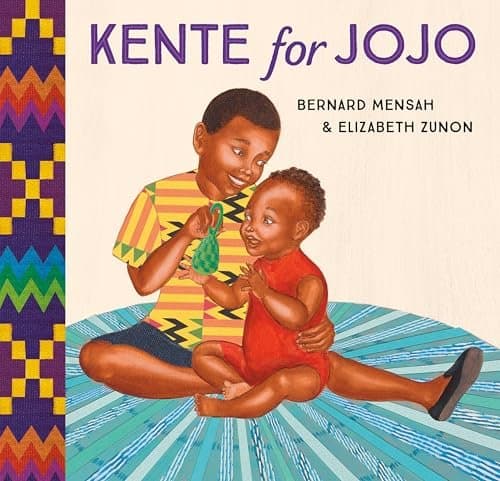
Kente for Jojo
📦 Orders ship in batches of 50. Your copy is reserved once you pay.
A joyful picture book about a big brother who helps his family choose a special Kente cloth for new baby Jojo. Narrated by the older sibling, the family travels to a traditional weaving workshop in Bonwire, Ghana, where the brother learns the legend of Kente — how the spider Ananse inspired two hunters to weave — and even tries the loom himself. When his weaving goes slightly wrong, the imperfection becomes what makes Jojo's Kente truly special. The pattern they choose is Nyankonton — God's eyebrow, the rainbow — symbolising beauty, uniqueness, and great luck.
For schools and libraries
Bring this story into your classroom or library
Download teacher resources, ask about class sets, or invite Bernard for a reading and workshop built around the book.
Perfect for…
Peek inside
Reviews (3)
★ Starred“A gorgeous, reverent celebration of a cherished symbol of African tradition.”
— Kirkus Reviews
“Mensah's vivid storytelling is as inviting as Zunon's colorful illustrations.”
— The Horn Book
“A fascinating exploration of this weaving tradition, its origins, and the techniques used.”
— School Library Journal
You might also like
English-language printables with teacher notes for the classroom or home.
Kente for Jojo classroom activity pack
A complete pack combining printable activities, teacher notes, timings, support and suggested teaching links. English-language PDF and web edition.
A gift for baby Jojo
Book-specific questions about the older sibling, the family’s choice of cloth and a gift made with care, with drawing responses and teacher notes.
Paper weaving and pattern studio
An original paper loom template, cutting guide and design grid, with over-under instructions and an explanation that paper weaving is a classroom model.
Something special to me
A drawing frame and sentence starters about an object, gift or family memory, with an option to invent rather than share personal information.
Kente: cloth, craft and care
A short sourced fact sheet, four true-or-false statements with answers, and a Ghana atlas task. It recognises varied weaving traditions rather than universal colour meanings.